This info brief looks at research conducted by the Center for Inclusive Design and Environmental Access (IDEA Center) at the University at Buffalo, funded by the National Institute on Disability, Independent Living, and Rehabilitation Research (NIDILRR). The brief highlights key findings and implications related to transportation systems, workplace design, and universal design strategies that support access to employment for people with disabilities. The information in this brief is intended for employers, transportation professionals, policymakers, disability advocates, workplace designers, and people with disabilities.
Overview
- Employment participation depends on more than just workplace accessibility. Transportation systems, workplace environments, and practices all influence whether people with disabilities can access, participate in, and keep a job.
- Universal design (UD) expands beyond minimum accessibility requirements by supporting usability, comfort, independence, wellness, and inclusion for a wide range of employees and job seekers.
- Findings from NIDILRR-funded transportation and workplace studies highlight opportunities to support getting to, being at, and keeping a job.
BACKGROUND
Employment participation for people with disabilities depends on their successful navigation all aspects of work, from accessing the workplace to effectively engaging in workplace tasks, interactions, and environments.1,2 This includes getting to work through transportation systems that support access and mobility, being at work in environments that support performance, inclusion, and well-being, and sustaining participation in work as individual needs, technologies, and workplace practices evolve over time
While accessibility standards help reduce barriers, they do not always address broader issues related to usability, comfort, independence, wellness, and social participation.3,4 Universal design (UD) expands standards beyond minimum accessibility requirements by creating transportation systems and workplace environments that support a wider range of users and experiences.
This information brief presents findings from research conducted by the Center for Inclusive Design and Environmental Access (IDEA Center) at the University at Buffalo through a series of current and former Rehabilitation Engineering Research Centers (RERCs) and Field Initiated Projects (FIPs) funded by the National Institute on Disability, Independent Living, and Rehabilitation Research (NIDILRR)1. These research programs investigated transportation systems and workplace environments that influence participation in employment and civic life for people with disabilities. Research areas include transit boarding and wheelchair securement systems, on-demand transportation services, workplace post-occupancy evaluations (e.g., how a space performs after people start using it), and workplace experiences of employees with neurodivergent sensory processing needs.
1 This includes the RERC on Accessible Public Transportation (90REGE0007), the RERC on Universal Design and the Built Environment (90REGE0015), the FIP on Optimizing Accessible Public Transportation (90IFRE0010), and the recently awarded RERC on Universal Design Applications (90REGE0031).
2 The isUD program provides more than 500 Universal Design solutions to help organizations evaluate, improve, and design more inclusive facilities. It also offers certification for projects that demonstrate the implementation of Universal Design. See https://thisisud.com/
KEY RESEARCH FINDINGS
 Transit Boarding
Research on boarding ramps for large accessible transit vehicles found that gentler ramp slopes improved ascent times and were considered easier and more acceptable across users with physical and sensory disabilities.
In contrast, steeper slopes increased boarding difficulty and the need for assistance for some users, particularly manual wheelchair users.5
 On-Demand Transportation Services
Interviews with transit agencies found that on-demand transportation services expanded mobility options for people with disabilities by providing more flexible scheduling and same-day trip availability than traditional paratransit services (e.g., rides for people who are unable to independently use regular public transit) alone.8 Surveys with users of both paratransit and on-demand transportation services found that on-demand services were valued for their flexibility, including same-day booking, real-time information, and shorter wait times. However, many users continued to use traditional paratransit services because of their affordability, advance scheduling options, and better hours and coverage areas than some on-demand services.
User satisfaction was influenced more by operational factors such as wait times and driver professionalism than by the type of transportation service itself, highlighting the importance of service reliability and quality in supporting mobility.9
 Wheelchair Securement Systems
Research on two newer wheelchair securement systems, a three-point forward-facing tiedown and a semi-automated rear-facing system, found that the semi-automated system reduced the need for operator assistance and was perceived as supporting greater independence for many wheelchair users. However, research also identified challenges with the semi-automated system, including system design limitations and policy constraints, that contributed to misuse or nonuse, highlighting the need for further improvements to better accommodate the diverse needs of mobility device users.Superscripts 6,7
 Post-Occupancy Evaluations
According to a post-occupancy evaluation (POE) study, employees with and without disabilities in a UD-certified workplace (i.e., certified by Innovative Solutions for Universal Design [isUD])Superscript of 2. Refer to footnote reported more positive experiences with navigation, usability, and workspace options than employees in the comparison workplace. The study still identified challenges associated with open workplace design, including noise, reduced privacy, and unclear boundaries between circulation and work areas.10
Building on the previous POE research, we are further examining how workplace design and indoor environmental conditions (e.g., comfortable temperatures and lighting) affect health, well-being, and job performance among employees with neurodivergent sensory issues in the new RERC on Universal Design Applications.
Advancing Universal Design
Regulatory and accessibility standards are essential to evidence-based building design because architects rely on experts to translate research into clear guidelines.11 However, adoption of UD is often slowed by disagreements on its application and confusion around compliance with the Americans with Disabilities Act.12 With NIDILRR funding, the IDEA Center addressed this by developing voluntary UD standards through the innovative solutions for Universal Design (isUD) website and certification program, which includes over 500 UD strategies that go beyond existing building codes and promote safety, health, and social participation. isUD has been applied across diverse settings, including corporate, financial, hospitality, cultural, and recreational environments. It supports adoption by providing a clear framework for implementation, branding opportunities, reduced legal risk, and improved user performance and satisfaction. Ongoing efforts continue to expand and refine isUD to better meet the needs of both users and design professionals.
IMPLICATIONS
 Transportation Professionals and Policy Makers
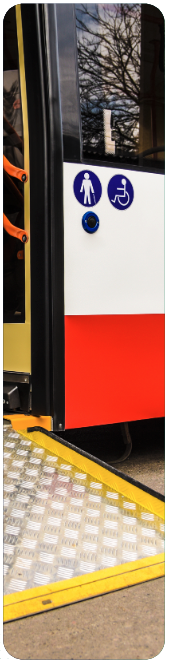
The transportation studies highlight that access to employment depends on more than simply providing transportation options. Vehicle boarding, wheelchair securement, travel information, and service delivery all influence whether people can travel safely, independently, and reliably. Findings suggest that transportation systems should support a range of user needs by focusing on:
- accessible vehicle design, ensuring ease of entry, boarding, and use;
- wheelchair securement systems, accommodating diverse mobility devices anduser needs; and
- flexible service options, supporting different travel needs.
Continued improvements may further support independence and access to work, including:
- boarding and securement technologies that reduce assistance needs,
- user interfaces that provide clear information and feedback, and
- automation technologies that support independent use of transportation systems.
Additionally, transportation systems can support more positive user experiences by:
- providing multiple transportation options,
- offering real-time information for better trip planning, and
- ensuring predictable travel experiences.
Together, these features can support greater choice, flexibility, and independence in the journey to work.
 Employers

The workplace studies demonstrate that inclusive employment requires more than physical accessibility. Creating positive workplace experiences involves attention to:
- inclusive wayfinding systems (e.g. tactile floor guidance, large, high contrast lettering, universal symbols), supporting ease of navigation throughout the workplace;
- diverse workspace options (e.g., accessible workplaces, sensory friendly rooms),accommodating different work styles and needs; and
- supportive indoor environments (e.g., accessible layouts, ergonomic furniture,natural lighting) enhancing comfort and usability.
At the same time, effective workplace design should balance multiple priorities, including:
- collaboration and productivity,
- comfort and privacy, and
- a wide range of user needs and preferences.
Beyond physical design, inclusive workplaces also rely on:
- an organizational culture that values inclusion,
- employee engagement in shaping workplace practices, and
- ongoing efforts to understand and respond to employee experiences.
Together, these findings suggest that sustaining participation in employment requires continuous attention to both transportation and workplace environments. This includes:
- recognizing that employee needs, technologies, and workplace practices change over time;
- moving beyond one-time accessibility solutions or accommodations; and
- prioritizing ongoing evaluation, maintenance, and continuous improvement.
These efforts help ensure that transportation systems, workplaces, and organizational practices remain usable, adaptable, and supportive of long-term participation in work.
 RELATED RESOURCES
REFERENCES
- 1. Shahin, S., Reitzel, M., Di Rezze, B., Ahmed, S., & Anaby, D. (2020). Environmental factors that impactthe workplace participation of transition-aged young adults with brain-based disabilities: A scopingreview. International Journal of Environmental Research and Public Health, 17(7), 2378. https://doi.org/10.3390/ijerph17072378
- 2. Tessier, A., Clément, M., Gélinas, I., Boucher, N., Croteau, C., Morin, D., Turcotte, M. A., & Archambault,P.(2023). The impact of transportation on the employment of people with disabilities: a scoping review.Transport Reviews, 44, 85–111. https://doi.org/10.1080/01441647.2023.2229031
- 3. Steinfeld, E., & Maisel, J. (2012). Universal design: Creating inclusive environments. John Wiley &Sons.
- 4. Paul, G., Steffan, I. T., Itoh, N., Bowman, R., & Bradtmiller, B. (2022). Design for all – Design for disabled:How important is anthropometry? Work, 73(s1), S57–S65. https://doi.org/10.3233/wor-211106
- 5. Perez, B., Lenker, J., Paquet, V., Choi, J. and Steinfeld, E. (2017). Ascent and Descent Performance in Simulated Low-Floor Bus Ramp Deployment Conditions. U.S. Access Board.
- 6. Choi, J., Maisel, J. L., Perez, B., Nguyen, D., and Paquet, V. (2021). User Experiences with Two New Wheelchair Securement Systems in Large Accessible Transit Vehicles. Transportation Research Record,2675(2), 150–161. https://doi.org/10.1177/0361198120954436
- 7. Choi, J., Maisel, J. L., Perez, B., & Paquet, V. (2023). Video observations and large accessible transit vehicle operator evaluations of two wheelchair securement systems. Transportation Research Record,2677(12), 423–435. https://doi.org/10.1177/03611981231168128
- 8. Choi, J., & Maisel, J. L. (2022). Assessing the implementation of on-demand transportation services for people with disabilities. Transportation Research Record, 2676(5), 437–449. https://doi.org/10.1177/03611981211067976
- 9. Choi, J., & Maisel, J. L. (2025). Comparing user experiences with traditional ADA paratransit and on-demand mobility services. Transportation Research Interdisciplinary Perspectives, 33, Article 101562.https://doi.org/10.1016/j.trip.2025.101562
- 10. Maisel, J.L., Choi, J., Perez, B., and Weidemann, S. (2026). Evaluating the Effectiveness of Universal Design Implementation in a Workplace Environment. [Manuscript in preparation]
- 11. Vaughan, E., & Turner, J. (2013). The value and impact of building codes. Environmental and Energy Study Institute. https://www.eesi.org/papers/view/the-value-and-impact-of-building-codes
- 12. Watchorn, V., Hitch, D., Grant, C., Tucker, R., Aedy, K., Ang, S., & Frawley, P. (2019). An integrated literature review of the current discourse around universal design in the built environment – is occupation the missing link? Disability and Rehabilitation, 43(1), 1–12. https://doi.org/10.1080/09638288.2019.1612471
The contents of this document were developed under grant number 90DPEM0011 from the National Institute on Disability, Independent Living, and Rehabilitation Research (NIDILRR). NIDILRR is a center within the Administration for Community Living (ACL) of the U.S. Department of Health and Human Services (HHS). The contents of this document do not necessarily represent the policy of NIDILRR, ACL, or HHS, and you should not assume endorsement by the federal government.